
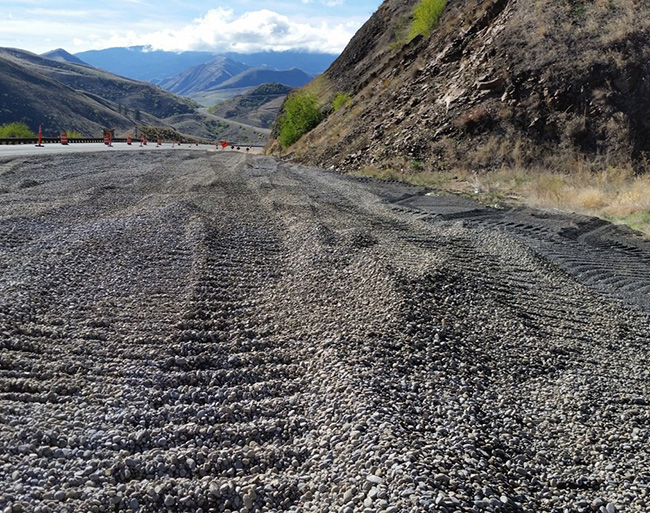
Concrete gravel replaced the pea gravel on this ramp on White Bird Hill on US-95.
D2’s gravel selection improves runaway truck ramp performance

Gravel matters when it comes to runaway truck ramps, and District 2 started upgrading its old ramps with new material after noticing trucks progressing farther and farther after leaving the road.
Ramps range in length but usually have between three and four feet of gravel. They work by building up material around a truck’s axles and locking the wheels. 
Pea gravel is a fine material that easily collects water and dust, and in colder months, those contaminants can cause the ramp to bind up, limiting its effectiveness.
Larger rocks in three-quarters concrete aggregate drain well and do not compact, requiring less maintenance to keep the material loose and capable of halting large loads.
The switch was inspired after Doral Hoff, now the district engineer, researched Colorado Department of Transportation practices. D2 maintenance crews take front-end loaders with a ramp rake attachment—an innovation developed in-house by Josh Allen—to the region’s twelve ramps each fall and spring, but there’s no dedicated funding to do more.
Despite that, the district upgraded select ramps on the Lewiston grade and White Bird Hill in recent years.
“We are very pleased with the performance of concrete aggregate ramps,” Hoff said. “Trucks are traveling much shorter distances as they traverse onto the ramps.”
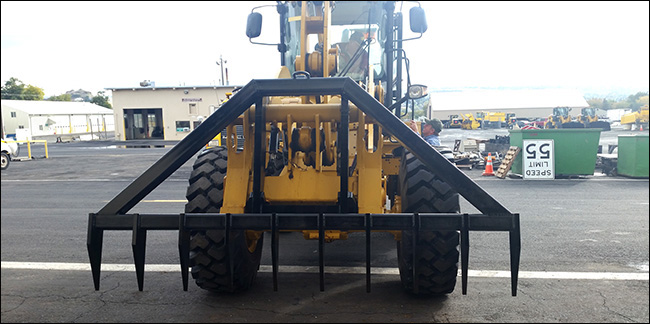
Rake attachment for a loader made by Josh Allen. Previously, crews used a grader with ripper shanks on the back, but the shanks weren't as long, and graders aren't as easy to maneuver.
Published 01-10-20